What People Make With AI Music: 1,471 Songs Analysed
By FlowTiva · September 23, 2026 · Industry Insights
Everyone has an opinion about AI music. Very few people have looked at what people actually do with it once the novelty wears off. We have: Flowtiva is a streaming platform built for AI-generated songs, so every track made on it passes through the same catalogue. We took all of them, 1,471 finished songs made between July 2025 and September 2026, and counted.
How we counted
The sample is every completed song on Flowtiva from 11 July 2025 to 22 September 2026, public and private: 1,471 tracks. Genres come from the tags each song carries (a song can carry several, so they add up to more than 100%). The language is the language of the vocals. Lengths are measured on the final audio. Structure comes from the lyric sheet each creator wrote. Nothing here identifies a person; these are counts over the whole catalogue.
Electronic music is what AI does first
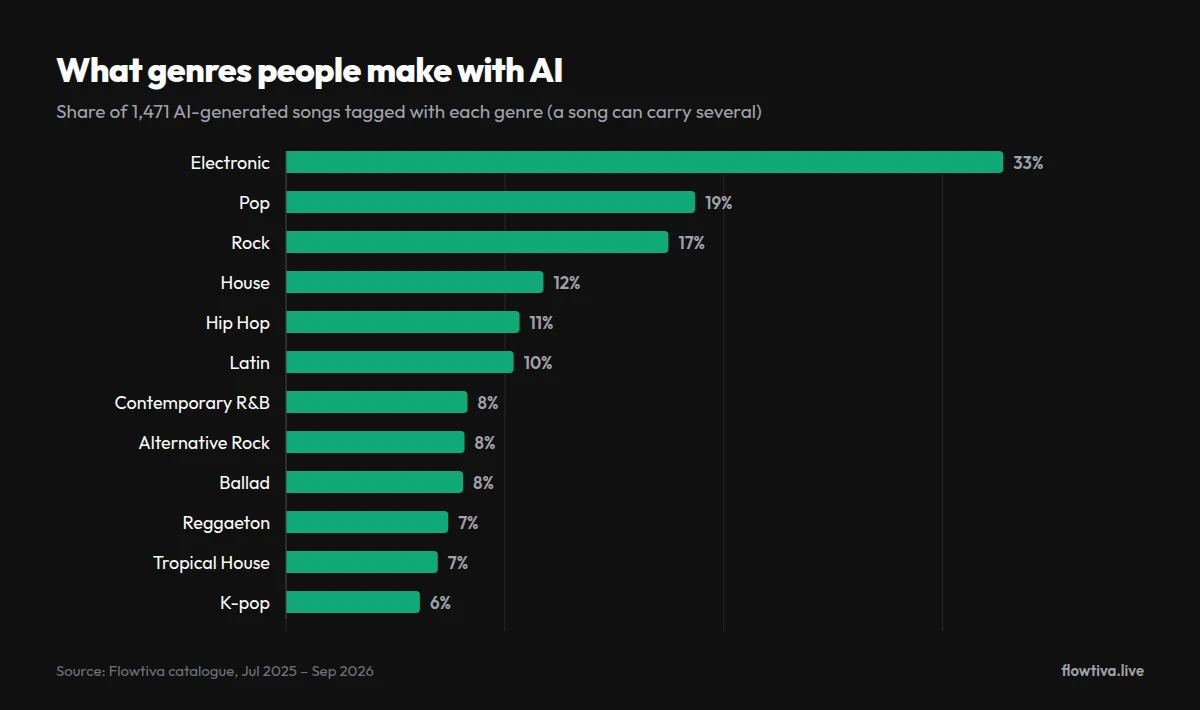
A third of all songs are tagged Electronic. That is not surprising once you think about how people make them: electronic music is built from textures, loops and synthesised sounds, which are exactly what generators render convincingly, and it forgives a slightly unusual vocal far more than an acoustic ballad does. Pop (19%) and Rock (17%) follow, then House, Hip Hop and Latin at 10–12% each.
The long tail is the interesting part. Across the catalogue we counted 182 distinct genres, from reggaeton and K-pop to bolero, fado and norteño. Once the cost of trying a style drops to a couple of minutes, people try a lot of styles. Many creators on Flowtiva publish in six or more genres, which is why the platform lets one account run several artist names.
English dominates, Spanish is a strong second
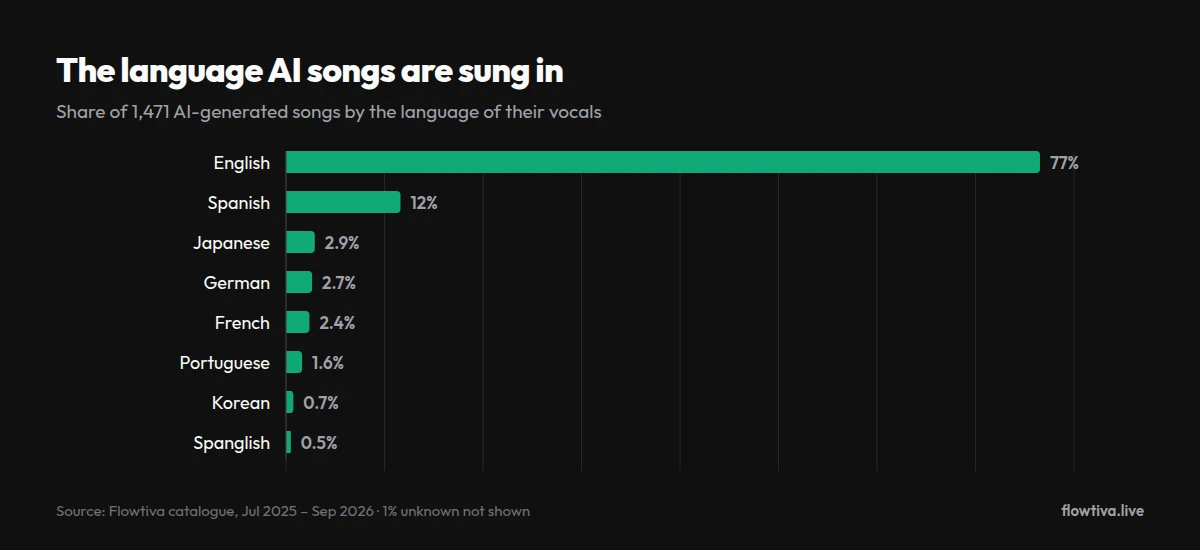
77% of songs are sung in English and 12% in Spanish, which leaves every other language together below 12%. Japanese, German and French sit around 3% each. There is even a small but real group of Spanglish songs that switch language mid-verse, something that used to need a bilingual singer and now needs a bilingual lyric sheet.
For creators this is a useful signal: English is crowded, and a good song in Spanish, Portuguese or Japanese has far fewer neighbours to compete with.
AI songs are radio length
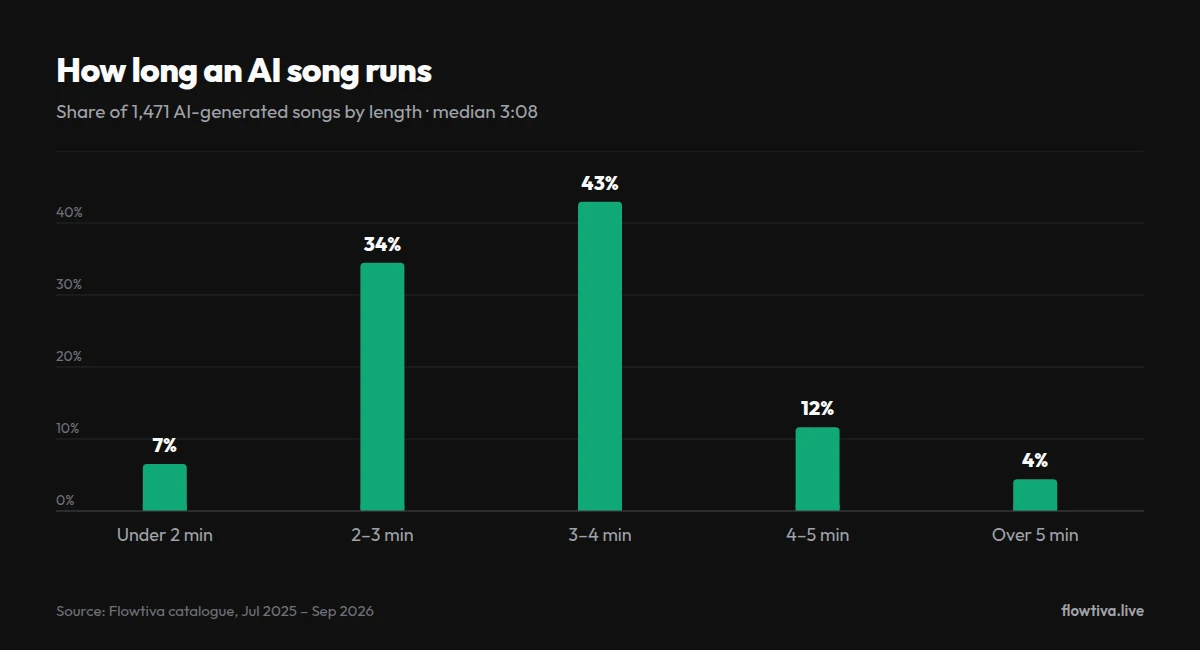
The median song is 3 minutes 8 seconds, and 77% land between two and four minutes, the same window commercial radio has favoured for decades. Only 4% run past five minutes. Part of that is the tools: most generators produce a single pass of a few minutes, and a longer song usually means a longer lyric sheet. But it also says something about intent. People are not generating ambient hours or experimental suites; they are making songs.
People still write lyrics, and they write them in sections
96% of songs have vocals. The median song has 36 sung lines of about six words each: a verse, a chorus, another verse, the chorus again, a bridge and a final chorus is roughly what that adds up to.
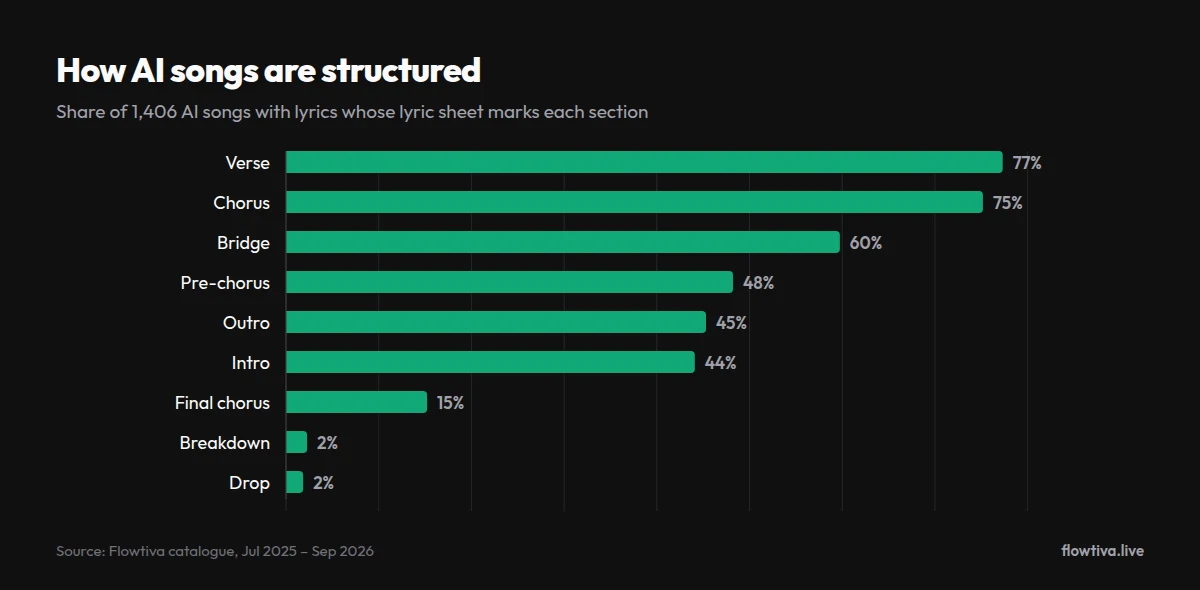
Most creators do not just paste lyrics. They structure them: 77% of lyric sheets mark their verses in square brackets, 75% mark a chorus and 60% a bridge. Nearly half add a pre-chorus. Those tags are how you tell a generator where the song lifts, and the numbers say people have learned that it works. If you are new to this, our guide on how to write lyrics for an AI song generator goes through the tags one by one.
Two more habits stand out:
- 45% of lyric sheets carry production notes inside the tags, such as
[Verse – palm-muted riff, 68 bpm]. The lyric sheet has become half lyrics, half brief to a producer. - 34% use parentheses for backing vocals, such as
Say you're coming home (coming home). It is the cheapest way to make a chorus sound like more than one voice.
Half of what gets made is never published
Of the 1,471 songs, 752 are public; the other 49% stay in their creator's private library. And 42% of all songs are the second take of a generation, since some engines return two versions of every request. The picture that emerges is closer to a studio than to a factory: people generate, listen, keep the take they like and release a fraction of it.
The short version. The typical AI song is a three-minute electronic or pop track, sung in English, written by a person in verses and choruses, and chosen from at least two takes. Half never leave the drafts folder.
What this means if you make AI music
- Electronic and pop are crowded. They are also where AI sounds best, so quality matters more than novelty there.
- Language is a niche. One song in eight is in Spanish and fewer still in anything else, so there is room to stand out.
- Structure your lyrics. The creators who get the most out of generators write sections, not paragraphs.
- Curate. Publishing your best take instead of every take is what most people already do, and it is what keeps a catalogue worth listening to.
You can hear what all of this sounds like on the Flowtiva catalogue, or pick a genre on Flowtiva Radio and let it play.
You are welcome to cite these figures and the charts above; please link back to this page as the source.